
Stock market today: Wall Street is mixed as DC moves to avoid default
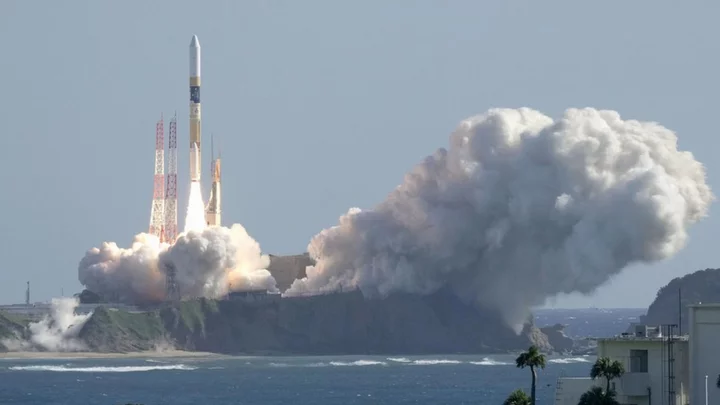
Wall Street is drifting in mixed trading after Washington struck a tentative deal to avoid a potentially disastrous default on its debt
2023-05-30 22:52
Britney Spears: 2023 net worth of singer whose marriage with Sam Asghari is in 'deep trouble'
It was reported that Britney Spears and Sam Asghari were arguing quite frequently and had physical altercations
2023-05-17 15:24
Sudan begins a cease-fire ahead of a pledging conference to raise funds for humanitarian assistance
Sudan’s warring parties have begun a cease-fire, as two months of fighting pushed the African nation into further chaos
2023-06-18 16:53
Auckland Airport to Double Airline Charges to Fund New Terminal
New Zealand’s busiest airport plans to double the fees it charges airlines over the next four years as
2023-06-08 07:54
Mapped: The damage caused by Ukraine’s devastated dam
War-torn Ukraine is reeling from the collapse of the Nova Kakhovka hydroelectric dam, which saw its reservoir burst causing chaos for miles around. The catastrophe on Tuesday forced thousands of residents of nearby towns and villages to evacuate their homes as the floodwater barrelled towards them and left some climbing onto rooftops or into trees to escape the raging torrents. Hundreds of thousands more have been left without access to clean drinking water in the region as a result of the eco-disaster on the Dnipro River, prompting relief workers to rush fresh supplies to the area as they struggle with the problems of mass resettlement. While the official tallies report that over 2,700 people have fled from flooded areas on both the Ukrainian and Russian-controlled sides of the river, a true picture of the disaster has yet to emerge given that more than 60,000 people live in the vicinity. Kyiv has blamed Russia for deliberately destroying the Soviet-era infrastructure, with Moscow, inevitably, protesting its innocence and contemptuously suggesting that Ukrainian saboteurs are responsible. Ukraine’s president Volodymyr Zelensky has called the incident “a war crime” and the “largest man-made environmental disaster in Europe in decades”. Russia would certainly appear to have the most to gain from the disaster and President Zelensky did warn as long ago as last November that he believed enemy soldiers had mined the dam and were plotting its destruction. He reiterated that stance in a tweet on Tuesday: “It is physically impossible to blow it up somehow from the outside, by shelling. It was mined by the Russian occupiers. And they blew it up.” For now though, the priority remains coming to the aid of the stricken people of Kherson. Ukraine’s deputy prime minister Oleksandr Kubrakov has warned of the threat to their wellbeing posed by hazardous chemicals and infectious diseases carried by the water as well as from landmines previously placed near the war’s frontline, which have been disturbed by the floods and are now likely to explode. The water in the reservoir feeds a wide area of southern Ukrainian farmland, including the annexed peninsula of Crimea, as well as providing all-important cooling water to the Russian-held Zaporizhzhia nuclear plant, lying nearby as indicated on the map below. A United Nations nuclear watchdog has attempted to reassure the public by saying that there is “no immediate risk” to the plant, even if it were to run out of water for its cooling systems. There is no such good news for the region’s farmers, however, with the flooding expected to spell instant disaster for this year’s harvest: crops are likely to be washed away, fields left waterlogged and livestock drowned in water that is at serious risk of being contaminated by machine oil, already seen gushing into the Dnipro. The depleted reservoir is also considered unlikely to be able to supply adequate irrigation to the surrounding fields for several years to come, a huge setback for Ukraine’s eventual hopes of economic recovery. All of which is also likely to have consequences for a global food market that has increasingly relied upon Ukraine for the supply of agricultural produce since the end of the Cold War. “There is no doubt that this will lead to large-scale environmental, economic and human consequences,” Mykhailo Podolyak, a chief adviser to President Zelenksy, told The Independent. “The instantaneous death of a large number of fish and animals, the waterlogging of drained lands, and the change in the climatic regime of the region, will later be reflected in the food security of the world. “A one-time reduction of water in a huge reservoir will lead to unpredictable ecological consequences.” Mr Podolyak warned that he expected the floodwaters to reach Mykolaiv, lying 56 miles from the dam and decried the drowning of the entire population of animals at the Kazkova Dibrova zoo on the Russian-held eastern bank of the river as particularly tragic. President Zelensky has already rebuked the officials installed by Moscow to run occupied territories along that bank for failing to respond adequately to the emergency. The Russian authorities he criticised have conceded that they have evacuated fewer than 1,300 people so far in an area where as many as 40,000 people were said to be affected. That compared unfavourably with the estimated 1,700 evacuated on the Ukrainian side to the west, where the population was reportedly around 42,000. According to the independent Russian news outlet Vyorstka, residents of the Moscow-run village of Oleshky, for one, remain stranded, the publisher quoting one woman as saying that her mother, who could not make it to the roof, was in the water clutching a ladder. A volunteer confirmed to Vyorstka that those still awaiting evacuation included children and disabled people. Civilians in Kherson itself were seen clutching personal belongings as they waded through knee-deep water in the streets and rode rubber rafts. Video on social media showed rescuers carrying others to safety and what looked like the triangular roof of a building floating downstream. Aerial footage showed flooded streets in the Russian-controlled city of Nova Kakhovska itself, where Mayor Vladimir Leontyev said seven people were missing, although they were believed to be alive. But perhaps most striking of all has been the aerial shots of the region captured by Maxar Technologies, which give the fullest picture of the damage done seen so far. Additional reporting by agencies Read More Ukraine-Russia war news – live: Exploding mines float through floodwater after Kherson dam attack Massive destruction after Ukraine dam collapse revealed in new satellite images Watch view of flooding in Kherson after destruction of Dnipro river dam The Body in the Woods | An Independent TV Original Documentary The harrowing discovery at centre of The Independent’s new documentary
2023-06-08 06:28
Sam Bankman-Fried's father, ex-Trump staffer among possible trial witnesses
By Jody Godoy and Luc Cohen NEW YORK Sam Bankman-Fried's father and brother, as well as Donald Trump's
2023-10-04 03:54
'Affront to democracy': Concern about appointing Mississippi judges where most are elected
Three residents of Mississippi’s capital city say their rights are undermined by a new state law that would create a court inside Jackson with judges who are appointed
2023-05-11 08:28
India Probe Finds No Sign Yet of Regulatory Failure on Adani
A committee appointed by India’s top court said that it doesn’t see any regulatory failure or signs of
2023-05-20 07:28
US House Republicans seek to unite around a new speaker
By David Morgan and Andy Sullivan WASHINGTON Republicans in the U.S. House of Representatives will try to unite
2023-10-11 18:28
Does MrBeast play God? YouTuber stunned as troll questions his intentions behind philanthropist efforts: 'He got your attention at least'
The troll argued that by helping others, MrBeast was somehow attempting to take up the role of the government by providing aid to those in need
2023-07-31 16:50
Southern EU nations urge for a new migration and asylum deal and beefed-up surveillance
Leaders of nine southern European countries are calling for the EU to finalize a new migration and asylum deal
2023-09-30 02:17
Sons of newly-identified Gilgo Beach murder victim Karen Vergata ‘weren’t warned by police’
The sons of a newly-identified Gilgo Beach murders victim reportedly were not notified by Long Island police before her name was revealed to the public. Suffolk County District Attorney Ray Tierney held a press conference on Friday to announce that the victim known only as Jane Doe 7 had finally been identified as Karen Vergata, more than 26 years after her partial remains were first discovered along the Long Island shores. Vergata, 34, was last seen alive in Manhattan in 1996 while working as an escort. The huge breakthrough in the case comes almost three decades after some of Vergata’s remains were first discovered – and just weeks after Rex Heuermann, a 59-year-old father-of-two architect, was arrested and charged with the murders of three other Gilgo Beach victims. Mr Tierney told reporters that Vergata had been positively identified via DNA in August 2022 but investigators kept the development under wraps due to the ongoing investigation into Mr Heuermann. Officials refused to comment on whether or not her murder may be linked to the suspected serial killer. The district attorney also attributed the delay to the need to contact Vergata’s family members. However, it has since emerged that Vergata’s two biological sons - Eric and Gary Doherty - apparently were not informed before Friday’s announcement. Eric’s girlfriend Michelle Nolan told the New York Post that he only found out after the press conference when they were contacted by the woman who adopted them as young children a few years before Vergata’s death. Ms Nolan said Eric was distraught, having believed that Vergata was only missing. Mr Tierney’s office did not return the Post’s request for comment about family notification, the outlet reported. Ms Nolan said Eric and Gary grew up with little knowledge of their biological mother after having been adopted by Edward and Diane Doherty in 1992. She explained that Vergata had been struck by a truck while she was pregnant with Gary in the late 1980s, which is thought to have led to him being born with cerebral palsy. Shortly after Eric was born in 1990, Vergata “took off”, Ms Nolan said. “She was a drug user and their father took her and helped her,” she said. Ms Nolan said the boys’ father was believed to have died from tuberculosis, but she wasn’t sure when. She said that Gary is now living in an facility for adults with special needs and has not been informed about his mother’s death. Vergata vanished without a trace around 14 February 1996 – Valentine’s Day, according to officials. She lived on West 45th St in Manhattan and is believed to have been working as an escort at the time of her disappearance. Police said that no missing persons report was filed at the time. On 20 April 1996, a woman’s legs were found wrapped in plastic at Davis Park on Fire Island’s Blue Point Beach. Almost exactly 15 years later on 11 April 2011, the woman’s skull was then found off Ocean Parkway during the search for Gilgo Beach victims. The skull was located close to the remains of another unidentified victim – Jane Doe 3, also known as Peaches. The two sets of remains in Fire Island and Ocean Parkway were later found to belong to the same person. Before now, investigators had long been unable to identify Jane Doe 7 – and the victim became known as Fire Island Jane Doe. She was described only as a white woman aged 18 to 50 years old who had several notable scars including evidence of surgery on her left ankle. She was one of 11 victims whose remains were found dumped along the shores of Gilgo Beach back in 2010 and 2011 – several of whom are also yet to be identified. Decades later, investigators were finally able to identify Fire Island Jane Doe using genetic geneaology and her surviving relatives’ DNA. In August 2022 – around six months after the new Gilgo Beach taskforce was launched – a DNA profile suitable for genealogical comparison was developed from the remains of the victim, officials said in a press conference on Friday. The next month, the FBI was able to presumptively identify the victim using genetic genealogy as Vergata. Then, that October, investigators tracked down a relative of Vergata and took a buccal swab. Using this, they were able to definitively identity the victim as Vergata. At Friday’s press conference, Mr Tierney said investigators kept that breakthrough hidden until now due to both the ongoing investigation into Mr Heuermann and the need to contact all of Vergata’s family members. “Prior to disclosing, we needed to contact all Vergata’s family members and around the same time we were beginning the grand jury confidential investigation into the murders of the victims known as the Gilgo 4,” he told reporters. ”So we decided not to make it public... until the results of that investigation became public and we had made notice to Vergata’s family.” He added: “Today we are here to announce that as part of the Gilgo taskforce’s reexamination of all evidence in the case we are able to identify Fire Island Jane Doe as Karen Vergata.” “It is important that we remember and honour not only Ms Vergata but all the vicitms on Gilgo Beach,” he added. While this marks a major breakthrough in the case, many questions still remain. In Friday’s press conference announcing her identity, Suffolk County officials refused to take any questions and would not comment on whether or not Vergata’s murder could be the linked to Mr Heuermann – who has so far been tied to four of the victims found along the Long Island shores. At this time, no one has been charged in connection to her homicide and her cause of death is unknown. DA Tierney said that while there are “no charges at this time”, that the “confidential investigation” is ongoing. He would not confirm or deny any ties to accused killer Rex Heuermann – or say if there was any potential suspects on his radar. “We are going to continue to work this particular case as we did the Gilgo Four investigation,” he said. “We’re not going to comment on what – if any suspects – we developed at this time. This is a confidential investigation so I’m not going to be taking any questions.” This major development comes as prosecutors are seeking to obtain a swab of DNA from Mr Heuermann, the man arrested and charged with the murders of three of the victims and suspected of a fourth killing. In a court filing this week, prosecutors said that the DNA sample would “provide further relevant evidence of the defendant’s identity as the perpetrator of the crime”. Prosecutors have so far obtained hundreds of hours of footage from the suspect’s home in Massapequa Park and his office in Midtown Manhattan, 2,500 pages of documents, crime scene photographs and autopsy reports in the high-profile case. The trove of evidence was turned over to Suffolk County Supreme Court Justice Timothy Mazzei and Mr Heuermann’s attorney Michael Brown on Tuesday as the accused killer appeared in court for a brief preliminary hearing. Suffolk County DA Tierney said last week that a “massive amount of evidence” had been recovered from the home which Mr Heuermann grew up in as a child – and which he went on to share with his family up until his sudden arrest. No human remains were discovered, but a trove of around 270 guns were seized from the home. The DA previously revealed that they believe at least some of the murders may have taken place inside the home. Mr Heuermann’s wife and two adult children were out of town at the time of each of the three murders he is charged with, according to court records. The 59-year-old architect was taken into custody on 13 July, almost 13 years after the bodies of at least 11 victims were discovered along the shores of Gilgo Beach on Long Island. He was charged with the murders of Megan Waterman, Melissa Barthelemy and Amber Costello. He is also the prime suspect in the murder of Maureen Brainard-Barnes – who was last seen alive in early June 2007 in New York City and who, with the three other women, is known as the “Gilgo Four”. All four women worked as sex workers and disappeared after going to meet a client. They were all found in December 2010 within one-quarter mile of each other, bound by belts or tape and some wrapped in burlap – their bodies dumped along Gilgo Beach. They are among 11 victims whose remains were found along the shores of Long Island in 2010 and 2011, sparking fears of one or more serial killers. As well as looking into his connection to the murder of Brainard-Barnes and the other Gilgo Beach victims, law enforcement agencies are now also looking into unsolved murders and missing persons cases all across the country. Police in Las Vegas and South Carolina – where Mr Heuermann owns properties – and Atlantic City – where several sex workers have been found murdered – have confirmed they are eyeing the suspect in cold cases. Court records show that Mr Heuermann was linked to the “Gilgo Four” murders through a tip about his pickup truck, a stash of burner phones, “sadistic” online searches, phone calls taunting victims’ families, his wife’s hair found on the victims’ bodies – and a pizza crust. The first piece of the puzzle came when a witness in the Amber Costello case revealed details about a vehicle that a client was driving when she was last seen alive. Costello, who worked as a sex worker, was seen alive on the evening of 2 September 2010 when she left her home in West Babylon. A witness said she had gone to meet a client who was driving a first-generation Chevrolet Avalanche. Last year, a registration search showed that local man Mr Heuermann owned a first-generation model of the truck at the time of Costello’s disappearance. He also matched the witness’ description of the man believed to be the killer: a large, white “ogre”-like male in his mid-40s, around 6’4’ to 6’6” tall, with “dark bushy hair,” and “big oval style 1970’s type eyeglasses”. The discovery of the car led investigators to hone in on Mr Heuermann including executing 300 subpoenas, search warrants and other legal processes to obtain evidence to determine his potential involvement in the killings. Among this was Mr Heuermann’s alleged use of burner phones, with prosecutors saying that he used burner phones to contact the three women and arrange to meet them at the time when they went missing. He also allegedly took two of the victims’ cellphones – and used one to make taunting phone calls to one of their families where he boasted about her murder, court documents state. Mr Heuermann’s DNA was found on one of the victims, while his wife’s hair was found on three of the four women he is connected to. Following his arrest, his wife Asa Ellerup filed for divorce. She has since told The New York Post that she has been left filled with “anxiety” and their two children “cry themselves to sleep” over the horror. “I woke up in the middle of the night, shivering... anxiety,” she said. “My children cry themselves to sleep. I mean, they’re not children. They’re grown adults but they’re my children, and my son has developmental disabilities and he cried himself to sleep.” Mr Heuermann’s sudden arrest comes after the horrific serial killer case has captured the nation’s attention for more than a decade. The Gilgo Beach murders had long stumped law enforcement officials in Suffolk County who believed it could be the work of one or more serial killers who targeted sex workers and dumped their bodies along the remote beaches on Ocean Parkway. The case began in May 2010 when Shannan Gilbert vanished after leaving a client’s house on foot near Gilgo Beach. She called 911 for help saying she feared for her life and was never seen alive again. During a search for Gilbert in dense thicket close to the beach, police discovered the remains of another woman. Within a matter of days, the remains of three more victims were found close by. By spring 2011, the remains of a total of 10 victims had been found including eight women, a man, and a toddler. Police have long thought that it could be the work of one or more serial killers. Gilbert’s body was then found in December 2011. Her cause of death is widely contested with authorities long claiming that it is not connected to the serial killer or killers but that she died from accidental drowning as she fled from the client’s home. However, an independent autopsy commissioned by her family ruled that she died by strangulation and her mother believes she was murdered. Like Gilbert, most of the victims targeted were sex workers, while some are yet to be identified. Read More Gilgo Beach murders - live: Police identify victim Karen Vergata but won’t comment on Rex Heuermann link Gilgo Beach murders victim Jane Doe 7 identified as Karen Vergata 26 years after remains discovered More families await answers in Gilgo Beach killings – and the names of other victims How the Gilgo Beach serial killer turned the Long Island shore into a graveyard
2023-08-05 23:58
You Might Like...
How did Joanna Merlin die? Broadway star and 'Law & Order' actress was 92
Florida officials approve tougher punishment for college staff who break new restroom rules for transgender people
Who was Malessa Mooney? Budding model and real estate agent found murdered in her Los Angeles apartment
Call to arms: Thousands of Revolutionary War stories are waiting to be told. A new project asks the public to help uncover them
County agrees to $12.2M settlement with man who was jailed for drunken driving, then lost his hands
New England Patriots star Jack Jones arrested at airport with two firearms in his bag
How Lebanon's Hezbollah group became a critical player in the Israel-Hamas war
Redistricting fights in these 10 states could determine which party controls the US House