J3N Provides the Latest and Most Up-to-Date News, You Can Stay Informed and Connected to the World.
⎯ 《 Just 3 N : New News Now 》
DuckDuckGo founder says Google's phone and manufacturing partnerships thwart competition
The founder of the small search engine company DuckDuckGo is testifying against Google in the biggest antitrust trial in a quarter of a century
2023-09-22 05:47
Avril Lavigne didn't want to be tied down with rebound Tyga after Mod Sun breakup: 'He was an easy distraction'
Tyga and Avril Lavigne 'come from different worlds and their worlds do not overlap. It was good for what it was,' a source said
2023-06-21 19:20
20 miles from the Russian border, one town struggles to move on from bloody occupation by Putin’s forces
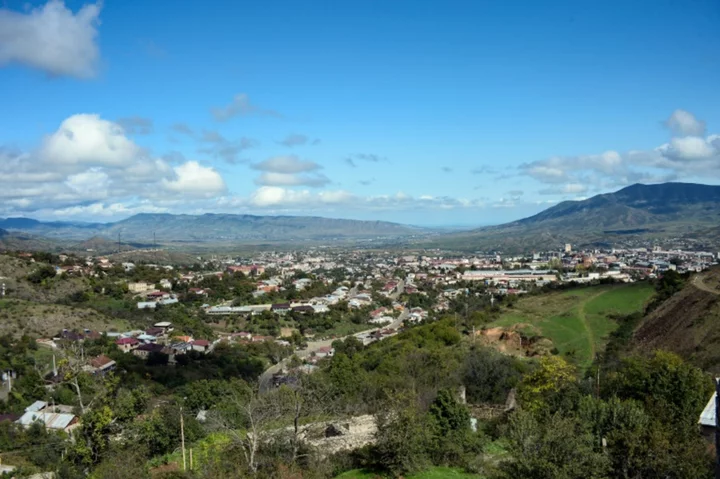
Nobody believed the Russians would really invade, says Yuriy Bova, mayor of the small Ukrainian town of Trostyanets, just 20 miles from the Russian border – but 24 February 2022 will forever be etched in his mind. As Russian tanks trundled across the border in the early hours of the morning, there were no Ukrainian troops in Trostyanets – in Ukraine’s eastern Sumy region – and the residents of the town knew the enemy would arrive within hours. Bova says they tried as best they could to slow down the Russian advance. Felling trees onto the roads through the rolling hills and forests surrounding Trostyanets, brought one column of invading vehicles to a halt for two days. However, it wasn't enough. “There weren’t just four or five armoured vehicles, as we had imagined. Instead, there was another column with more than 100 vehicles, including up to 60 tanks and armoured personnel carriers, 20 troop-carrying trucks plus fuel tankers,” Bova says. The Russians rumbled into Trostyanets on the first day of the invasion, beginning a nightmare for the town’s 21,000 inhabitants. I'd heard about the plight of the town a month later, on 27 March – when it was freed from Russian occupation. In the intervening weeks, much of the town was destroyed, 49 of its people were killed and 13 others believed “disappeared” by the occupiers. I was in another area of Ukraine – and knew nobody in Trostyanets – but started to dial numbers I could find. The first person to answer was on a number for the “Hotel Trostyanets". The woman who answered, Tetyana Shevchenko, the hotel’s owner had just returned to her town. I could hear her trying to muffle her sobbing as she told me about how the hotel had been utterly trashed. Everything that could be stolen, such as TVs, fridges and air-conditioners, had been looted, while beds, furniture, even doors had been smashed. However, even while absorbing the destruction at the business she and her husband spent years building, Tetyana said she felt lucky compared to others whose relatives had been killed or homes had been reduced to piles of charred rubble. Such a refusal to surrender to despair is a trait that was to become ever more apparent across Ukraine. I finally managed to visit Trostyanets recently, more than 15 months into a war Moscow appeared sure would only last weeks. Hotel Trostyanets was easy to find on the town’s main street, standing intact as part of a row of burned and battered husks of buildings. The town, founded in 1660, contains onion-domed churches and a fortress enclosed by a stone white-painted wall, built in the mid-18th century. During the occupation, the Russians positioned heavy artillery inside, calculating – correctly – that Ukrainian forces would not target a structure listed as a historic treasure. The building was unscathed by Ukrainian shelling but its walls are peppered with bullet holes from machine-gun fire in a bile-filled farewell by the fleeing Russians. Every street bears some scars. The railway station and shops, restaurants and residential buildings that had fringed a large square and park are a scene of total devastation, with most of the structures blasted beyond redemption. The park is a churned-up mixture of tarmac and soil. Eerily perched at its centre, atop a high concrete pedestal, is a Second World War-era Soviet T-34 tank. One of its treads, hit by shellfire, trails limply. When the Russians arrived, they commandeered the hotel and kicked Tetyana out. She said they immediately set out to inspire terror in the town, whose people were often beaten or detained, without rhyme or reason. Many men were forced to strip at gunpoint and stand on the street throughout freezing nights, she says. “They intimidated people, looted shops. Soon they started rounding people up for torture. They used the basement at our railway station as a torture chamber, where they did whatever they wanted,” Tetyana adds. “They understood that we were frightened of them and they behaved even more arrogantly, they enjoyed it.” Two of her friends, a married couple, were riding bikes when the Russians shot at them without warning, says Tetyana. The woman died but the Russians “wouldn’t let her body be moved for burial and she lay there until the Russians left”. Tetyana is active in local politics and was head of the local election commission. She feared the Russians would eventually come for her and she and her daughter managed to leave in mid-March to western Ukraine. Both their husbands had previously left and were in the Ukrainian military. Tetyana and her husband started repairing their hotel as soon as the Russians left, using their savings – as well as help from the local authorities. She gives a wry smile as she shows a photo of the door of room number six, where a Russian scrawl indicates a Russian commander had stayed. The door will be part of a planned museum about the town’s occupation. The situation on the battlefield is now somewhat different. Ukraine has been pushing a counteroffensive to take other territory occupied by Russia in the south and east, and the border area not far from Trostyanets has become the centre of cross-border incursions by pro-Ukrainian forces. The bulk of these have been carried out by Russian partisans seeking to cause trouble for president Vladimir Putin. The Russian Belograd region, between two and three hours’ drive from Trostyanets into Russian territory, has faced shelling, as well as the raids. But Trostyanets had seen its own version of guerrilla activity during the Russian occupation. The mayor, Bova, relays how it worked. A powerfully-built compact man, Bova was born in Trostyanets and was formerly a businessman. He was first elected as a councillor when he was 24 and has been the town’s mayor for 18 years. British and American intelligence had warned the Ukrainian government that the Russians had prepared detailed lists of people in government, military, police, education, social activists, businesspeople and others they suspected would help organise resistance and who were marked for arrest or execution. Bova says: “I had to decide whether to stay in my office and wait to be arrested and taken away or perhaps killed. That would have been madness. Weapons were in short supply – we had just four machine guns. So we couldn’t fight with that.” He and his comrades established contact with the Ukrainian 81st Brigade operating in the area and they asked his people to provide intelligence on what was going on inside Trostyanets. “They said that would be much more valuable than any fight we could have put up at that time,” says Bova, who became commander of Trostyanets’s territorial volunteer forces. Some of the Ukrainian partisans stayed inside the town while Bova and others operated from bases in forests close to Trostyanets, gathering detailed information about the Russian forces – including where they ate and slept and where their heavy weapons and armoured vehicles were at any time. They also helped guide Ukrainian artillery firing at Russian positions. Ukrainian intelligence believes one of the first of the many Russian generals to be killed during this invasion died in Trostyanets. Bova secretly visited the town twice to show the partisans he was close by and boost morale. On 21 March last year, they and Ukrainian regular forces launched an attack on the occupying forces in an attempt to liberate the town. But after a fierce firefight they had to withdraw. Bova says quite a few Russians were killed but so was one of the partisans. However, Ukrainian forces were encroaching on the town and the demoralised Russians, fearing being surrounded, fled on the night of 27 March across the border into Russia. Bova speaks to me inside his office at the town’s main administration building which, he says, like other public and community buildings in the town, had been looted and wrecked by the Russians. “The Russians smashed and destroyed everything. Three days before they left they fired some 30 tank shells into our main hospital... They also deliberately destroyed residential buildings. It was pure malice.” Bova suspects the 13 “disappeared” people were among those tortured beneath the railway station. Two prisoners were found alive in the basements as the Russians fled. They told of victims who bled to death after their fingers were cut off. Anguish flickers across Bova’s face as he recalls how the first thing the torturers demanded while beating their captives was his whereabouts. Since the town was liberated, Bova says he has worked tirelessly to rebuild Trostyanets. Electricity, water and heating systems were destroyed or ripped out. The town’s firefighting vehicles, ambulances, buses and any movable equipment was stolen. He said the Russians took even basic toolkits and wrecked what they could not take. He says all the tasks had to be performed in parallel – a huge logistical puzzle – and Bova reached out to and has been contacted by 130 organisations and groups around the world eager to help rebuild Trostyanets. In addition, scores of individuals have helped, many turning up unannounced to donate funds or supplies or roll up their sleeves to assist. He says everything from food, clothing and medicines to hospital apparatus, emergency vehicles and buses needed to be replaced “to return some semblance of normality”. “Today there are no homeless people in Trostyanets living under a tree,” he says. “Everyone has some roof over their heads.” But the tension never really leaves. The enemy is never out of reach, being so close to the border. Bova has a vision to rebuild Trostyanets using innovative designs from around the globe – taking into consideration factors such as the needs of elderly or disabled people and employing energy efficient and green technologies kind to the environment. “We know that we can’t invent everything ourselves when searching for new concepts,” he says. Therefore, he believes, to rebuild their country, Ukrainians need to forge partnerships with groups and individuals around the world to learn their approaches on incorporating culture, education parks and recreation into town planning. To that end he has traveled to the US, where among other projects he is seeking to adapt for Trostyanets “a new philosophy of park design” being developed by the city of Chattanooga in Tennessee. And last month he was in London for “The Ukraine Recovery Conference 2023” which was co-hosted by the UK and Ukraine and aimed at ensuring Ukraine can come back stronger from the devastation it has faced. Bova believes rebuilding Ukraine must begin even before the fighting is over. “We’ve mastered swiftly the technology of the new [Western] weapons we’ve been given. This is a people who didn’t break despite the horrors inflicted by the Russians and our nation is capable of swiftly mastering the technologies and ideas to rebuild our country.” He says so many people have died to ensure Ukraine survives and that it is “a duty to make every one of those sacrifices count – by building a new future they would be proud of and not recreating the past.” Read More The Body in the Woods | An Independent TV Original Documentary The harrowing discovery at centre of The Independent’s new documentary Sunak ‘discourages’ cluster bomb use after Biden agrees to send them to Ukraine Thousands march in Bosnia to mark 1995 Srebrenica genocide as ethnic tensions linger on Ukraine's president hails the country's soldiers from a Black Sea island to mark 500 days of war
2023-07-08 20:52
At least 21 dead after passenger bus plunges off bridge near Venice
At least 21 people have been killed after a passenger bus plunged from a bridge near Venice in an “apocalyptic” accident, say Italian authorities. The vehicle, which was carrying people returning from work, was travelling from Venice to Marghera when the shocking accident took place at the bridge in Mestre on Tuesday. “It completely went off the road, it flew off the bridge. It was a bus; it was a highway. We are in mourning,” Venice mayor Luigi Brugnaro told Italy’s national broadcaster RAI.
2023-10-04 05:55
Is Jake Paul a better boxer than Conor McGregor? Paulie Malignaggi thinks WWE star can make MMA fighter 'uncomfortable': 'He's got no balls'
Paulie Malignaggi explained that Jake Paul would not feel out of place in UFC due to his wrestling experience in high school
2023-06-29 13:50
Support for Black Lives Matter movement has dropped since 2020, report says
The Black Lives Matter movement has lost support among Americans in the past three years, according to a new study released Wednesday by the Pew Research Center.
2023-06-15 04:26
Now Cornell in hot seat as Megyn Kelly leads the ire after video of professor calling Hamas attack 'exhilarating' goes viral
In a speech caught on camera, Professor Russell Rickford expressed his view that Hamas' attack on Israel was 'exhilarating' and 'energizing'
2023-10-17 16:58
Streamy Awards 2023: Bella Poarch's gothic glamour takes center stage at red carpet, fans dub her ‘queen'
At this year's award ceremony, the singer made a stunning fashion statement in a mesmerizing dress designed by acclaimed fashion designer Do Long
2023-08-30 19:49
‘Margaritaville’ singer-songwriter Jimmy Buffett who died at 76 shared 3 children with wife Jane Slagsvol
'You've got to get away from whatever you do to make a living or other parts of life that stress you out,' said Jimmy Buffett once said
2023-09-03 02:53
Futures subdued after turbulent session, eyes on inflation data
U.S. stock index futures were subdued on Friday, with investors cautious ahead of the producer prices inflation data
2023-08-11 17:46
Monday night's $785M Powerball jackpot is 9th largest lottery prize. Odds of winning are miserable
The ninth-largest lottery jackpot will be on the line when numbers are drawn for a $785 million Powerball prize
2023-09-25 21:18
‘Weak’ Putin killed Wagner mercenary chief Prigozhin, Zelensky says
Vladimir Putin orchestrated the killing of Wagner mercenary boss Yevgeny Prigozhin thanks to his own weakness, Ukraine’s President Volodymyr Zelensky has said. The Ukrainian president made the off-hand remark during a conference in Kyiv on Friday, without providing any additional evidence. Mr Prigozhin died in an unexplained crash when a plane carrying himself and some of his top lieutenants went down when flying between Moscow and St Petersburg in late August. Mr Prigozhin offered the most severe challenge to the Russian president’s authority in more than 20 years in power when he and his Wagner fighters rose up against Moscow in June. The mutiny began when Mr Prigozhin’s forces left their base in southern Russia and marched on Moscow. It prompted the Kremlin chief to accuse Mr Prigozhin of "treason" and a "stab in the back". Mr Prigozhin and his troops were eventually halted 24 hours later, about 125 miles from the Russian capital, when a deal was brokered between the Kremlin and Mr Prigozhin by the Belarusian president, Alexander Lukashenko. See our live blog for the latest developments in Ukraine Mr Prigozhin had been in a public feud with Russian defence minister Sergei Shoigu and chief of the general staff Valery Gerasimov for months about the direction of Russia’s invasion of Ukraine, which is now in its 18th month. There has been a crackdown on dissent against the war across Russian society, with dozens facing prison sentences. Western leaders have suggested that little of note happens in Russia without Mr Putin’s sign-off and that he would be unlikely to let the embarrassment of the mutiny go without sending a message to others looking to undermine his presidency. Mr Zelensky said on Friday: "The fact that he killed Prigozhin - at least that’s the information we all have, not any other kind - that also speaks to his rationality, and about the fact that he is weak.” He made the statement in answer to another question about the Russian president. The Kremlin says all possible causes of the crash will be investigated, including the possibility of foul play. It has called the suggestion that Putin ordered the deaths of Mr Prigozhin and his men an "absolute lie". Many critics of Mr Putin have died in unclear circumstances during his 23 years in power, or narrowly escaped dying. Russia’s most recognisable opposition figure, Alexei Navalny, is facing decades in prison over various charges that are widely considered to be politically motivated. He was arrested in 2021 upon returning to Moscow after recuperating in Germany from what is believed to have been nerve agent poisoning. He has blamed that poisoning on the Kremlin, as did a number of Western nations. The Kremlin has denied involvement. Meanwhile, Mr Zelensky’s hometown Kryvyi Rih was one of several sites in Ukraine to be hit by Russian missiles overnight into Friday. Three people were also killed after a Russian bomb struck the village of Odradokamianka in the Kherson region of southern Ukraine. The strikes come as Ukraine is trying to push back Russian troops and reclaim its territory as part of a summer offensive. However, Mr Zelensky said that his nation is finding it harder and slower to secure sanctions on Russia and weapon supplies to help fend off Moscow's forces. He said Ukraine's three-month-old counteroffensive would make faster gains in the south and east if Kyiv's military received more powerful weapons. "The war is slowing down. This is true, we recognise this. All the processes are becoming harder and slowing down: from sanctions to the delivery of weapons," he said. Read More Wagner Group set to be declared a terrorist organisation The UK says it will declare Russia’s Wagner mercenary group a banned terrorist organization Wagner to be declared a terrorist organisation, Home Office says Sunak pledges to ‘put pressure’ on Moscow as he arrives in India for summit Cuba arrests 17 for allegedly helping recruit some of its citizens to fight for Russia in Ukraine Ukraine-Russia war – live: Four dead as Putin’s forces strike Zelensky’s hometown and Kherson
2023-09-08 23:54